

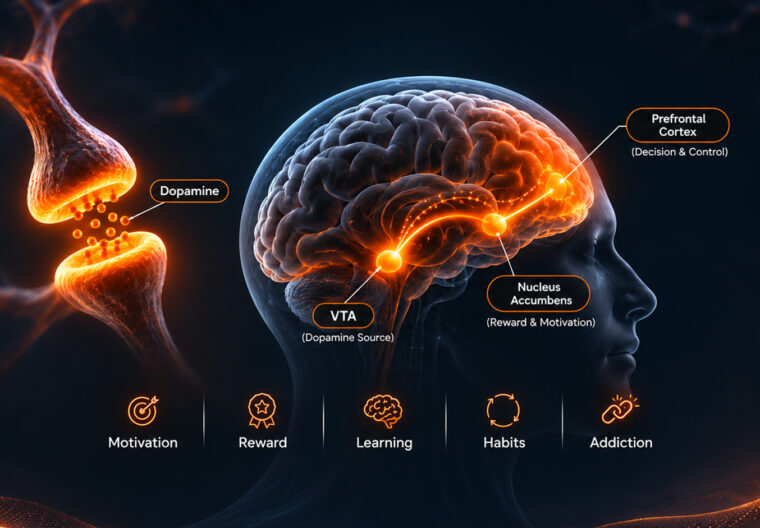
Dopamine and the Brain: Understanding Motivation, Reward, Addiction and Human Behaviour
Introduction: The Chemistry Behind Why We Want What We Want
Why do we sometimes spend hours pursuing a goal, struggle to concentrate on a difficult task, or repeatedly check our smartphones even when we know there is nothing important waiting for us?
The answer involves a fascinating neurochemical system in the human brain: dopamine.
Often described as the brain’s pleasure chemical, dopamine is much more than a molecule associated with happiness. It plays a central role in motivation, reward learning, attention, movement, decision-making and the anticipation of future outcomes.
Dopamine influences not only what we enjoy but also what we pursue, how much effort we are willing to invest and how our previous experiences shape future behaviour.
Understanding dopamine offers an opportunity to examine human behaviour from a neuroscience perspective. It helps explain why certain activities become habits, why unexpected rewards capture our attention and why addiction can develop even when the pleasure associated with a substance or behaviour decreases.
The central question is not simply how dopamine makes us feel, but how it influences what our brain decides is worth pursuing.
1. What Is Dopamine? Understanding the Neurotransmitter
Dopamine is a catecholamine neurotransmitter and neuromodulator involved in communication between neurons.
It is produced by specialised neurons, particularly in regions of the midbrain, including the substantia nigra and ventral tegmental area (VTA).
These neurons project to different brain regions, influencing several important functions.
Three major dopaminergic pathways are particularly relevant:
1. Mesolimbic pathway: Connects the ventral tegmental area with structures including the nucleus accumbens. It is strongly associated with reward processing, incentive motivation and reinforcement.
2. Mesocortical pathway: Connects the ventral tegmental area with cortical regions, particularly the prefrontal cortex. It contributes to aspects of cognition, attention, motivation and executive functioning.
3. Nigrostriatal pathway: Connects the substantia nigra pars compacta with the striatum. It plays an essential role in movement, motor learning and action selection.
These pathways demonstrate that dopamine is not exclusively a reward chemical. It participates in multiple neural systems that influence how we think, move, learn and behave (Wise, 2004).
2. Dopamine Is Not Just About Pleasure: The Science of Wanting vs. Liking
One of the most important contributions to dopamine research comes from the distinction between wanting and liking.
Imagine eating your favourite dessert.
You enjoy its taste. That pleasurable experience represents liking.
However, imagine seeing the same dessert advertised later in the day. Even when you are not hungry, the advertisement may create a strong desire to eat it.
That desire represents wanting.
Although these experiences often occur together, neuroscience suggests that they involve partially distinct brain mechanisms.
Berridge and Robinson (1998) demonstrated that dopamine’s role in reward cannot simply be reduced to producing pleasure. Dopamine is particularly important in incentive salience: the process through which reward-associated cues acquire motivational significance.
Their later work with Berridge (2016) further developed the distinction between wanting and liking.
This distinction has important implications.
A person may strongly desire something without experiencing the same degree of pleasure when obtaining it.
For example:
- You repeatedly check social media even when it no longer feels particularly enjoyable.
- You crave a particular food despite not being hungry.
- You continue pursuing a reward even when the satisfaction it provides has diminished.
In these situations, wanting and liking may become partially disconnected.
The neuroscience lesson: wanting something and enjoying something are not necessarily the same experience.
3. How Does the Brain Learn to Anticipate Rewards?
Dopamine is closely involved in a process known as reward prediction error (RPE).
Reward prediction error refers to the difference between an expected outcome and the outcome actually received.
Schultz, Dayan, and Montague (1997) demonstrated that the activity of dopamine neurons in primates can reflect differences between predicted and received rewards.
Consider three situations:
Situation A: An Unexpected Reward
You receive a reward that is better than expected.
This can produce a positive reward prediction error, supporting learning about the unexpected outcome.
Situation B: An Expected Reward
You receive exactly what you anticipated.
The reward prediction error may be relatively small because the outcome was already predicted.
Situation C: An Expected Reward Does Not Arrive
You expect a reward but do not receive it.
This can produce a negative prediction error, signalling that your previous expectation needs updating.
These signals help the brain refine predictions about the environment.
Why does this matter in everyday life?
Consider checking your email.
You open your inbox expecting nothing particularly interesting. Suddenly, you receive an unexpected job offer or an important message.
The outcome exceeds your expectation.
Experiences of this kind help explain why unexpected rewards can be particularly attention-grabbing.
Importantly, reward prediction error is a computational concept studied in specific neural systems. It does not mean every pleasant experience produces an identical dopamine response.
4. A Real-World Case Model: Why Is It So Difficult to Stop Checking Your Smartphone?
Consider a hypothetical case involving a young marketing professional.
Every morning, the individual wakes up and checks their smartphone. Initially, the purpose is practical: checking messages and notifications.
Over time, the behaviour becomes increasingly automatic.
A notification appears. The individual checks the phone. Sometimes there is an interesting message, a social interaction or an unexpected update. At other times, there is nothing particularly rewarding.
Yet the checking continues.
What is happening?
Stage 1: Cue formation
The smartphone notification becomes associated with potentially rewarding information.
Stage 2: Anticipation
The notification creates an expectation that something interesting might be available.
Stage 3: Behavioural response
The individual opens the application to discover the outcome.
Stage 4: Reinforcement
Occasional rewarding experiences strengthen the association between the notification and checking behaviour.
Stage 5: Habit development
Repeated behaviour in a consistent context may become increasingly automatic.
This example illustrates how reward learning and environmental cues can influence everyday behaviour.
However, it is important not to assume that every notification directly produces a measurable dopamine surge or that all smartphone use constitutes addiction.
The broader principle is that unpredictable rewards and learned environmental cues can influence attention and approach behaviour.
5. Dopamine and Addiction: When Wanting Becomes Difficult to Control
Addiction is one of the most important areas in which dopamine research has transformed our understanding of human behaviour.
Historically, addiction was often interpreted primarily through the lens of pleasure-seeking or weak self-control.
Modern neuroscience presents a more complex picture.
Addiction involves interactions between reward, motivation, learning, stress, memory and executive-control systems.
Repeated exposure to addictive substances can alter the functioning of neural circuits involved in reward processing and motivation.
Volkow, Koob, and McLellan (2016) describe addiction as a condition involving persistent changes in interconnected brain systems, including reward, stress and executive-control circuits.
The Incentive-Sensitization Theory
Berridge and Robinson’s incentive-sensitization theory offers an important explanation for why addiction can persist.
According to this framework, repeated drug exposure may sensitise neural systems responsible for incentive motivation.
Consequently, drug-associated cues can acquire excessive motivational significance.
The individual may experience powerful cravings even when the actual pleasure obtained from the substance has declined.
This explains an apparent contradiction:
Why would someone continue pursuing something that no longer makes them feel as good as it once did?
Because the motivational processes driving wanting can become partly separated from the pleasurable experience of liking.
This is not simply a failure of willpower. It involves learned associations and changes in the functioning of neural systems.
Addiction is a complex, treatable health condition, and recovery can require psychological, medical and social support.
6. Dopamine, Motivation and the Willingness to Work
Why are we willing to spend months preparing for an examination, building a business or developing a professional skill?
Motivation involves evaluating whether a potential outcome is worth the effort required to achieve it.
Dopamine contributes to this process.
Research suggests that dopaminergic activity influences effort expenditure, reward pursuit and the selection of actions based on anticipated outcomes.
Salamone and Correa (2024) review evidence demonstrating dopamine’s importance in the activational aspects of motivation and effort-based decision-making.
Consider two individuals:
- Person A prefers an immediate, relatively small reward.
- Person B is willing to invest considerable effort for a larger future reward.
Their decisions involve multiple interacting processes, including reward valuation, cognitive control, effort evaluation and future-oriented planning.
Dopamine contributes to motivational activation, but it does not independently determine ambition, discipline or success.
This distinction matters because motivation is not a single chemical event. It emerges from interactions between several neural and psychological systems.
7. Dopamine and Human Behaviour: Why Some Experiences Become Habits
Human behaviour is strongly influenced by learning, environmental cues and reinforcement.
Dopamine helps the brain learn which actions and stimuli are associated with important outcomes.
Consider three everyday examples:
Social media: Notifications, social approval and unpredictable updates can reinforce repeated checking behaviour.
Shopping: Anticipation of a purchase can motivate browsing and buying, even before the product is acquired.
Professional achievement: Progress, recognition and successful completion of challenging tasks can reinforce goal-directed behaviour.
These experiences are not identical, and dopamine is only one part of their underlying neurobiology.
Nevertheless, they demonstrate how reward-associated learning can influence repeated behaviour.
The important insight is that the brain learns from the outcomes of our actions, and these learned associations can influence what we pursue in the future.
8. Can We Regulate Dopamine? Moving Beyond the Dopamine Detox Myth
The popularity of dopamine detox has created considerable confusion.
Dopamine detox is often presented as a method of reducing dopamine levels by avoiding smartphones, entertainment, pleasurable food or other stimulating activities.
However, this is not an accurate description of dopamine biology.
Dopamine is essential for normal brain functioning. It cannot and should not be eliminated.
Nor does avoiding pleasurable activities for a short period literally reset the brain’s dopamine system.
A more scientifically defensible approach is to examine behaviours, environmental cues and habits that interfere with daily functioning.
Practical strategies include:
- Manage digital distractions: Disable unnecessary notifications and establish specific times for checking messages.
- Develop meaningful goals: Break larger objectives into manageable tasks and monitor progress.
- Prioritise physical activity: Regular exercise supports overall brain and mental health.
- Maintain adequate sleep: Sleep supports cognitive functioning and emotional regulation.
- Practise delayed gratification: Develop the ability to work towards meaningful long-term outcomes.
- Build healthier reward patterns: Encourage activities such as learning, creative work, social interaction and physical activity.
These strategies are not dopamine treatments. They are behavioural approaches that can help create a healthier relationship with reward, attention and motivation.
9. The Bigger Picture: Dopamine Is a System, Not a Shortcut to Happiness
Dopamine is often discussed in popular psychology as though it were a simple measure of happiness or motivation.
Scientific evidence suggests something much more interesting.
It is part of a sophisticated biological system that helps the brain evaluate outcomes, learn from experiences, assign motivational significance to environmental cues and energise goal-directed behaviour.
Understanding dopamine also helps us reconsider several common assumptions:
- More dopamine does not automatically mean more happiness.
- Strong desire does not necessarily indicate strong enjoyment.
- Addiction cannot be explained by dopamine alone.
- Motivation involves more than chemical stimulation.
- Human behaviour emerges through interactions between biological, psychological and environmental factors.
The real value of dopamine research lies in understanding how the brain converts experience into motivation and action.
Conclusion: Understanding What Drives Human Behaviour
Dopamine provides an important window into the neuroscience of human behaviour.
It helps explain why we pursue certain goals, learn from rewards, develop habits and sometimes struggle to disengage from behaviours that no longer serve us.
Perhaps its most important lesson is the distinction between wanting and liking.
We can desire something without enjoying it, anticipate rewards that never arrive and repeatedly pursue outcomes that provide diminishing satisfaction.
Understanding these processes allows us to look beyond simplistic explanations of motivation and addiction.
My perspective is that dopamine should not be understood merely as the chemistry of pleasure, but as part of the biological machinery through which expectations, experiences and motivations shape human behaviour.
The next time you reach for your smartphone, pursue a professional goal or find yourself repeating a familiar behaviour, consider the deeper question:
Are you pursuing the reward itself, the anticipation of the reward, or simply a behaviour your brain has learned to repeat?
That distinction is where neuroscience becomes particularly relevant to everyday life.
References (APA 7th Edition)
Berridge, K. C. (2007). The debate over dopamine’s role in reward: The case for incentive salience. Psychopharmacology, 191, 391–431. https://doi.org/10.1007/s00213-006-0578-x
Berridge, K. C. (2012). From prediction error to incentive salience: Mesolimbic computation of reward motivation. European Journal of Neuroscience, 35(7), 1124–1143. https://doi.org/10.1111/j.1460-9568.2012.07990.x
Berridge, K. C., & Robinson, T. E. (1998). What is the role of dopamine in reward: Hedonic impact, reward learning, or incentive salience? Brain Research Reviews, 28(3), 309–369. https://doi.org/10.1016/S0165-0173(98)00019-8
Berridge, K. C., & Robinson, T. E. (2016). Liking, wanting and the incentive-sensitization theory of addiction. American Psychologist, 71(8), 670–679. https://doi.org/10.1037/amp0000059
Salamone, J. D., & Correa, M. (2024). The neurobiology of activational aspects of motivation: Exertion of effort, effort-based decision making, and the role of dopamine. Annual Review of Psychology, 75, 1–32. https://doi.org/10.1146/annurev-psych-020223-012208
Schultz, W., Dayan, P., & Montague, P. R. (1997). A neural substrate of prediction and reward. Science, 275(5306), 1593–1599. https://doi.org/10.1126/science.275.5306.1593
Volkow, N. D., Koob, G. F., & McLellan, A. T. (2016). Neurobiologic advances from the brain disease model of addiction. The New England Journal of Medicine, 374(4), 363–371. https://doi.org/10.1056/NEJMra1511480
Wise, R. A. (2004). Dopamine, learning and motivation. Nature Reviews Neuroscience, 5, 483–494. https://doi.org/10.1038/nrn1406

